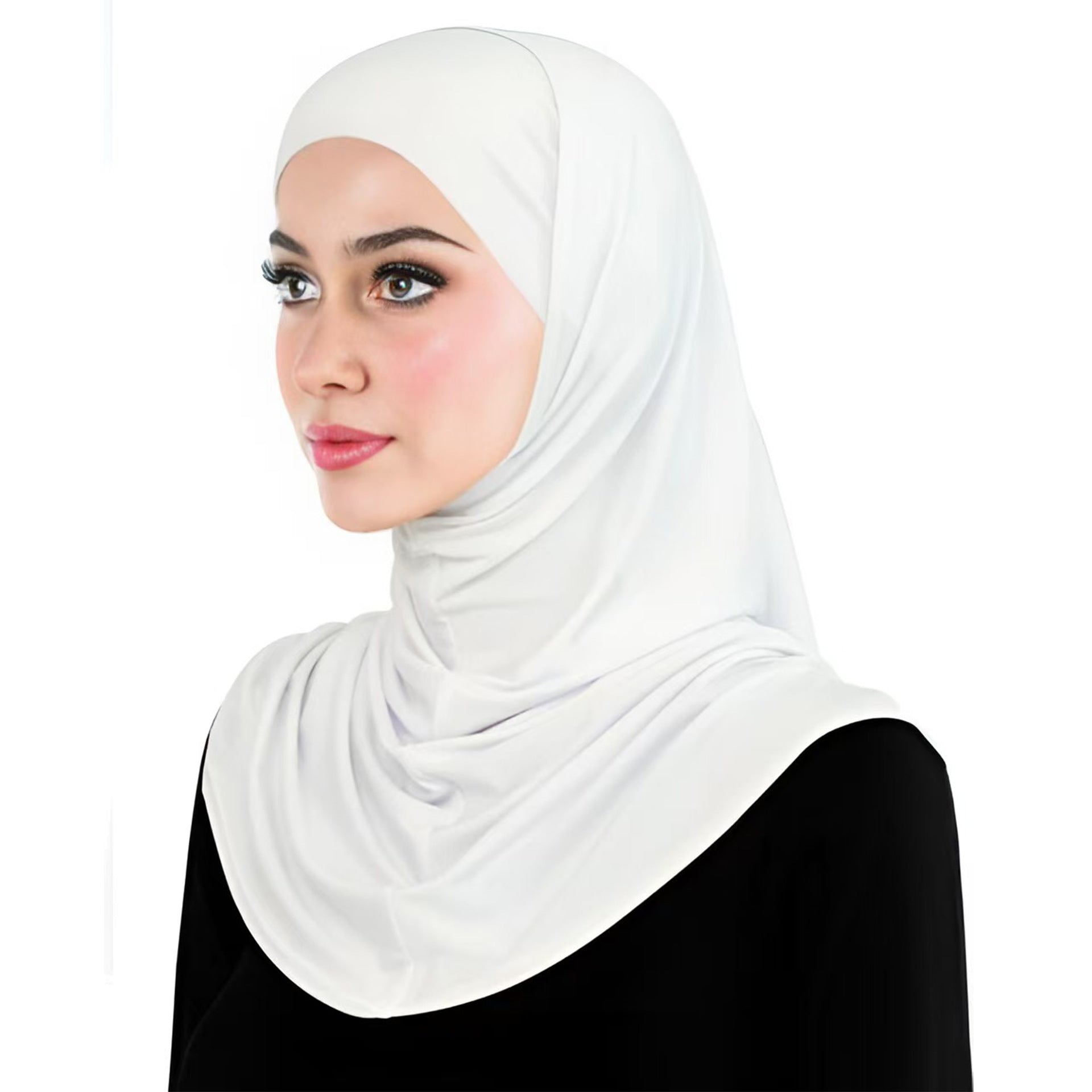
The right hijab undercap depends on what you need it to do. A simple tube cap can create a light base layer, a closed cap offers more complete hair coverage, a neck-cover style extends coverage below the jaw, and a tie-back cap lets you adjust the fit. Fabric, stretch, seam placement and the outer hijab matter just as much as the name of the style.
Use this guide to narrow the options, then check the measurements and construction of the exact product before ordering.
Quick Undercap Selector
| Your main priority | Start with | Check before choosing |
|---|---|---|
| A simple base layer for everyday wrapping | Tube cap | Opening, stretch, length and whether it stays in place with your hair type |
| More complete hair coverage | Closed cap | Crown depth, seam position and overall fit |
| Coverage around the neck or under the chin | Neck-cover cap | Neck length, face opening, closure and how it layers under clothing |
| A fit you can tighten or loosen | Tie-back cap | Tie length, lining, ear access and bulk at the back |
| A smoother base under a lightweight scarf | A low-bulk style | Edge thickness, seams and color visibility through the outer hijab |
This table is a starting point rather than a universal ranking. Two caps with the same format can feel different when their fabric, dimensions, elasticity or stitching changes.
1. Tube Caps: A Simple, Low-Bulk Starting Point
Tube caps are generally designed as stretchable bands or open-ended base caps. They are useful when you want a straightforward layer around the hairline without the additional fabric of a full-cover style.

TDF-01 Mercerized Cotton Jersey Hijab Cap is listed as a one-size cap weighing 0.03 kg, with a 69-color range. It is one example of how a basic cap can support broad color matching.
A tube cap may suit:
- Everyday wraps where low bulk is important
- Wearers who prefer to arrange their hair separately
- Color matching beneath plain or lightweight hijabs
- Retail assortments that need a simple entry-level undercap
Check whether the cap is open at the back or crown, how much it stretches, and whether the edge creates pressure around the hairline. Do not assume that “one size” will produce the same fit for every wearer.
Browse Tube Caps and Inner Undercaps.
2. Closed Caps: More Complete Hair Coverage
A closed cap covers the crown rather than ending as an open tube. This can make it easier to contain the hair in one layer, but the crown depth and seam placement determine whether the cap feels secure or creates excess fabric.

YS004 Cross-Pleated Cap shows a closed-cap construction with a shaped front. Decorative or shaped fronts should be evaluated both on their own and underneath the intended outer hijab.
A closed cap may be useful when you want:
- Hair contained within one base layer
- Fewer open edges at the crown
- A defined cap shape beneath the hijab
- A style that can also work with looser outer wraps
For sampling, inspect the crown seam and test the cap with different hair volumes. Too little depth can pull at the front edge, while too much fabric can create a visible bump beneath a smooth hijab.
Browse Closed Caps and Full-Cover Undercaps.
3. Neck-Cover Caps: Extended Coverage Around the Neck
Neck-cover undercaps extend below the head to cover part or all of the neck. Some are pull-on styles, while others use buttons, ties or separate openings. The important checks are the face opening, neck length and how the lower section sits beneath a top or abaya.

ND498 Modal Ninja Undercap has an extended pull-on shape around the head and neck. It is listed in modal at 0.03 kg, measures 24 x 35 cm and is available in 28 colors.
Choose this direction when neck coverage is part of the intended outfit rather than relying only on the outer scarf. Check whether the lower fabric remains flat when layered, whether the opening is comfortable around the face, and whether the style works with glasses or earrings if those are part of the use case.
Browse Neck Cover Caps and Undercaps.
4. Tie-Back Caps: Adjustable Fit and Hair-Volume Control
Tie-back caps use straps or extended fabric at the back so the wearer can adjust the tension. This can help accommodate different head shapes or hair volumes, but the ties and any lining can add bulk beneath a close-fitting hijab.

JN001 Satin-Lined Tie-Back Hijab Cap is listed in polyester at 0.045 kg, with ten colors and a 58 cm head-size specification.
Tie-back caps can suit customers who want:
- Adjustable tension rather than a fixed opening
- More control over where hair volume sits
- A lined option for a different interior hand feel
- Flexible fitting across a retail assortment
During a sample check, tie the cap at several tensions. Confirm that it stays secure without creating pressure and that the knot or gathered fabric does not show through the intended hijab.
Browse Tie-Back Caps and Adjustable Undercaps.
How Fabric Changes the Result
The cap format tells you where the product covers; the fabric affects stretch, grip, thickness and hand feel.
- Cotton and mercerized-cotton jerseys: often selected for a familiar knit feel, but the blend and knit density still matter.
- Modal jersey: can provide a soft, flexible base, although weight and recovery vary by product.
- Polyester and polyester blends: can support smooth, elastic or shaped constructions depending on the knit and finish.
- Satin-lined styles: change the interior surface but may be warmer or bulkier than an unlined cap.
- Mesh or perforated constructions: can reduce fabric density in selected areas; inspect coverage and durability as well as airflow.
Fiber names alone do not prove that one cap is cooler, more secure or more suitable for hair. Compare the finished construction and test the sample during the intended length of wear.
Match the Undercap to the Outer Hijab
An undercap should be evaluated as part of a complete combination:
- Under a sheer chiffon, check color visibility, edge lines and full hair coverage.
- Under a soft modal hijab, check whether the cap creates grip without changing the drape.
- Under a stretch jersey hijab, avoid unnecessary layers if the overall combination feels too close-fitting.
- Under an instant hijab, confirm whether the product already includes a cap or shaped inner layer.
- For light colors, test opacity using the actual cap and hijab colors together.
Undercap Sample Checklist for Buyers
Before building a retail color range or placing a repeat order, record:
- Cap format and exact coverage area
- Flat measurements and stretch range
- Fiber composition and fabric construction
- Crown depth, face opening and neck length where applicable
- Edge, seam, tie, button and lining construction
- Fit with different hair volumes and head shapes
- Color visibility beneath light outer hijabs
- Bulk beneath modal, chiffon and jersey hijabs
- Wash-test result and shape recovery
- Label, packaging and color-code requirements
Buyers can use the main Hijab Undercaps and Inner Caps collection to compare the wider range before narrowing by construction.
Frequently Asked Questions
What is the difference between a tube cap and a closed undercap?
A tube cap is generally open-ended and creates a band-like base around the head. A closed undercap covers the crown. Exact construction varies, so check the product photos and measurements rather than relying only on the name.
Which undercap is best for preventing a hijab from slipping?
There is no universal answer. Fit, fabric surface, hair type, outer-hijab fabric and styling method all affect movement. Test the complete combination and avoid excessive tension as a substitute for correct sizing.
Do I need an undercap with every hijab?
Not necessarily. It depends on the opacity, grip, construction and desired coverage of the outer hijab, as well as personal preference. Some instant hijabs already include an integrated cap or shaped inner section.
How should a boutique choose undercap colors?
Start with neutral shades that coordinate with the main hijab range, then add colors based on the actual assortment. Test light outer hijabs because the undercap color may influence the final appearance.
What should buyers confirm before ordering undercaps?
Confirm construction, measurements, stretch, material, color options and sample fit. For customized programs, also confirm labels, packaging, color references and whether the selected style supports the intended customization.
For product availability or sample questions, contact MinYang Manufacturer through the contact page or WhatsApp.